Bleaktide dev build 1 'Embryonic' available for download.
Download rar
Limitations
- 3 dungeons available, partially done.
- Only 1 to 2 abilities per class.
- Multiplayer disabled.
- Wailing Ghast class not yet playable.
Notes
- 6 classes ready to play. Any you think are nice or crap?
- Try graphics options. Let me know what you like.
- Frame-rate counter is at bottom left. Does it run okay?
- How are the abilities?
- Check out the slot machine.
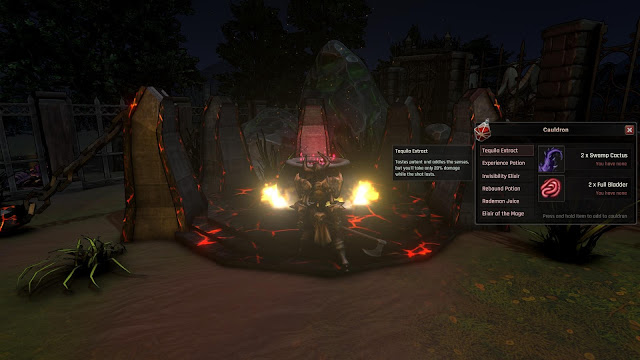
- Check out the potion cauldron.
Showing posts with label Bleaktide. Show all posts
Monday, June 15, 2020
Wednesday, May 20, 2020
Bleaktide Part 5: Gameplay Features
Posted by
Damien Classen
Note that this is part 5 of a series. In this installment I ramble on about miscellaneous gameplay features.
In this post I'll showcase a few gameplay features currently present or in progress. The screenshots are too large to fit at full size, so click them to view the full-size versions.
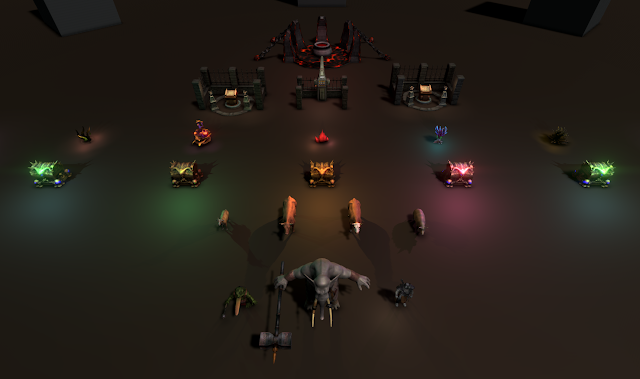
Dev World
Because the actual game worlds are quite large and filled with so many objects, loading them takes a while. It's not that long but when you're trying to repeatedly tweak new features you want to able to iterate quickly.
In this post I'll showcase a few gameplay features currently present or in progress. The screenshots are too large to fit at full size, so click them to view the full-size versions.
Dev World
Because the actual game worlds are quite large and filled with so many objects, loading them takes a while. It's not that long but when you're trying to repeatedly tweak new features you want to able to iterate quickly.
To cater for this I have a separate development world with a very basic background, containing a collection of game objects that I can enable or disable as needed. Similar scenes exist for testing game characters, abilities and gear in isolation, but 'dev world' is the one where I spend most of my time.
Slot Machine
Occasionally I'll lose focus and get side-tracked on some spur of the moment wild idea that doesn't really contribute to the core game. Although I kick myself for spending so much time getting side-tracked I do think that these arbitrary features end up being interesting mini-games that add character and flavor to the game.
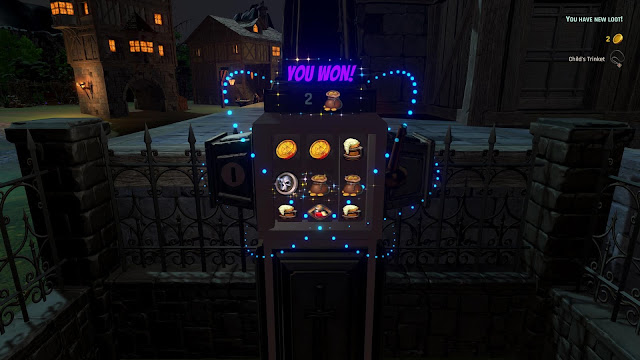
The slot machine was one of these. I spent about 3 or 4 evenings implementing it (it took longer than initially anticipated). The slot machine allows you to spend gold for a chance of winning gear and items.
Unlike your typical slot machine game I actually modelled and simulated the individual reels, like an old-school physical slot machine. It's bright and flashy and sort-of at odds with the grim theme of the game, but that's part of it's charm.
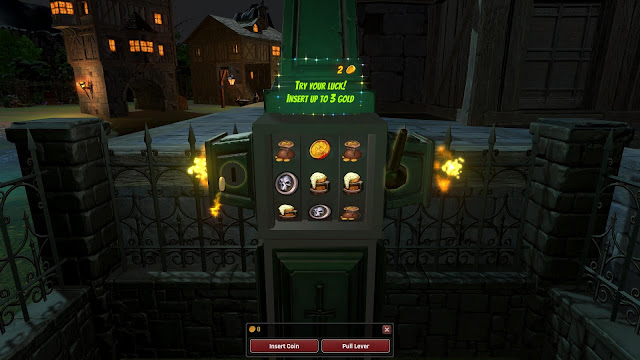
Part of what I like about my theme is that it combines dark and gritty with silly and comical. You'll be walking through an ominous graveyard and then come across a dancing skeleton who gets a fright when he sees you. After leaving the graveyard you might stumble upon this bright flashing slot machine. It admittedly feels a bit incongruous but it does add a strange and unusual feel to it all.
Reagent Harvesting
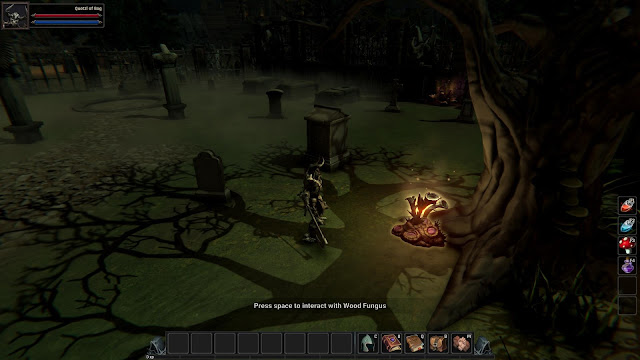
Reagents are ingredients that you harvest from certain plants that allow you to craft potions. To help you differentiate between reagent plants and general background plants, the ones that can be harvested are made more prominent using particle effects and lighting. Once you harvest them the special effects are disabled, making them blend into the background like ordinary plants.
![]() |
| The Crypt Lord has stumbled upon a wood fungus plant, which will allow him to harvest wood fungus to use at the potion cauldron later. |
Organ Harvesting Area
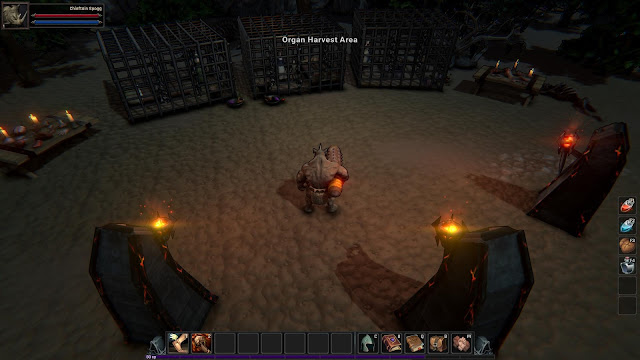
The organ harvesting area isn't an area where you actually harvest organs (I thought that would be a bit too disturbing, although I'm still open to the idea). It is a quest area where women and girls from the town have been captured. You need to discover what happened to them. You find them in cages and will eventually need to rescue them. Right now I've not actually implemented that part, so it feels quite gloomy because you see them and hear them crying but can't do anything about it.
The black market merchant you interact with in the town trades in organs, so it makes you wonder whether he is involved in this.
Potion Cauldron
The potion cauldron is where you craft potions using reagents you have collected. I have tried to make it very simple to use, while also trying to give it a tangible feel (as if you are actually interacting with a cauldron). It actually shows the ingredients dropping in and plays a rewarding sizzling sound and fancy liquid splash particle effects.
Rune Forge Area
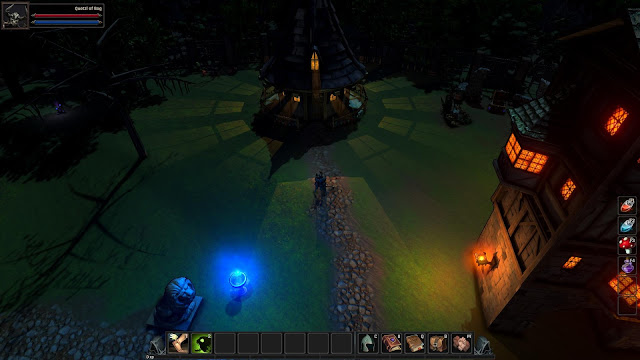
The rune forge area is not actually implemented yet, but it will be where you can use mined items (items like ore and crystals) to craft 'runes', which can be slotted onto armor and weapons to make them more powerful.
It's still a bit unclear to me exactly how this feature will work so I can't say much more about it right now. Hopefully it'll be splendid!
Lore Books
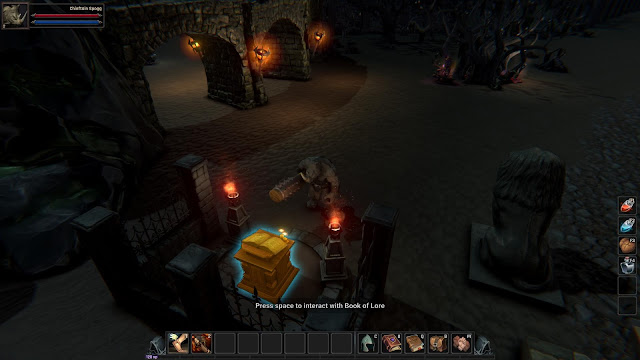
Lore books are one of the ways in which I expound upon the lore and history of the world. They are typically present near dungeon entrances to give some background information. Occasionally they are also present deep inside dungeons, telling stories about heroes and villains you'll encounter later.
An old friend, Matt Penney, offered to provide some voice acting, and I took up his offer for one of the lore books. I'm very happy with the results and am hoping he'll be amenable to providing more. Here is a link to the sample:
![]() |
| This rhino fella is standing next to a lore book. |
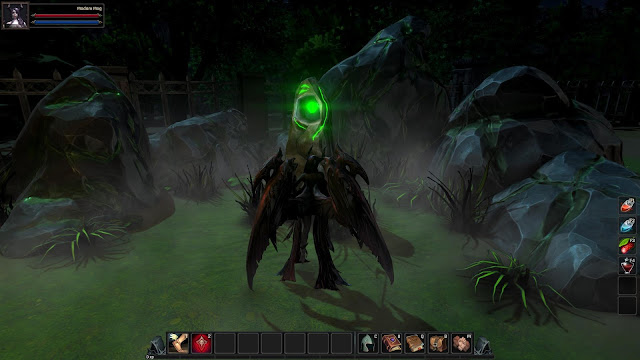
Arcane Stones
These mysterious artifacts serve a purpose that not even I know yet. They'll probably give you some boon or buff. The reason I'm still undecided on what to do with them is that you already have so many skills, abilities, brews and potions that give you buffs. Yet another buff-giving item feels inconsequential, so I'm still mulling over it.
![]() |
| What the heck does this thing even do? Not even I know. |
Abilities
I've divided character abilities into a set of shared abilities and class-specific abilities.
Shared abilities are things like 'dash' (which allows you to sprint for a while and navigate through the world more quickly) and 'illuminate' (which summons an orb of light to illuminate dark areas).
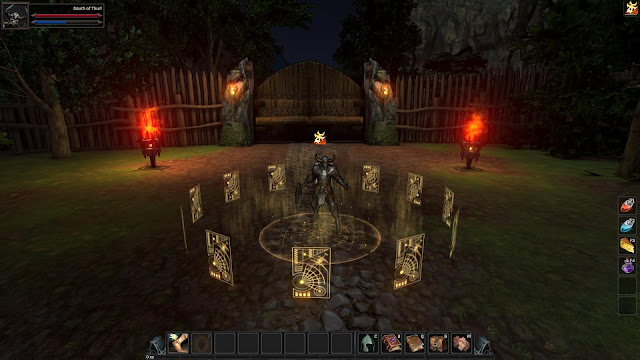
Class-specific abilities are obviously thematically related to the specific character. I've only got about one or two per class at the moment, and some of them are still works in progress.
![]() |
| The Dark Templar can summon the 'Shield of Ghaz'kar', which provides protection for him and any allies standing within it's sphere of influence. |
Color Schemes
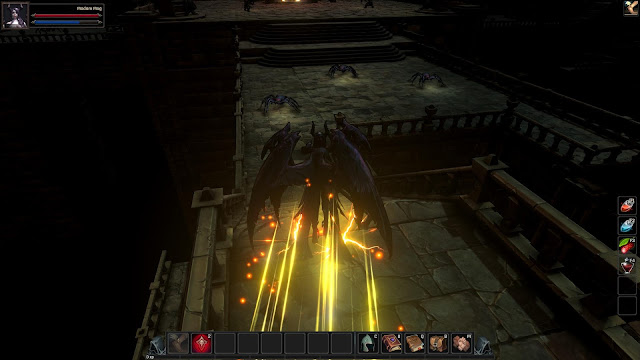
When showing the game to friends and colleagues I often get conflicting advice. Some want it more colorful, others advise making it grittier. Some like outlines, others don't. Some like intense bloom, others hate bloom and want it subtle to the point of almost not being present.
To deal with this nightmare I just chose to make all of these configurable via the graphics options. Outlines are optional, bloom intensity can be specified by the player, and there are several color schemes available (normal, grim and colorful).
Multiplayer Options
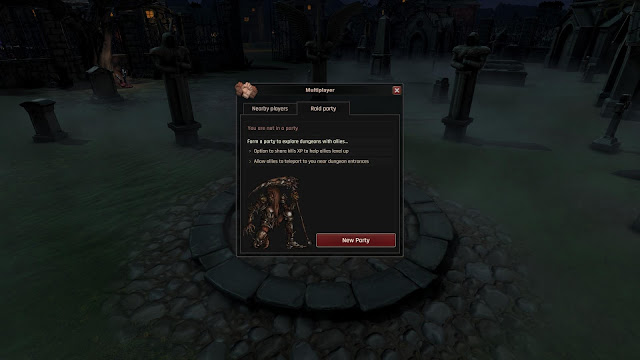
I started work on supporting multiplayer right from the start. It worked well at the time with the limited feature set present, but unfortunately, in trying to get the game fleshed out I've neglected it for a while. Nevertheless support for multiplayer features is somewhat present.
My initial intention was to have an MMO feel where you'd explore the town and other players would be exploring with you. I may still go this route, but if it proves too complex I may fall back to you exploring alone but then forming a raid party which invites other players to enter multiplayer mode to raid a dungeon together.
Sunday, May 3, 2020
Bleaktide Part 4: Game Development Process
Posted by
Damien Classen
Note that this is part 4 of a series. In this installment I'll start discussing some of the more technical and design related aspects of the game.
Up until now I've discussed the mood and theme and mostly just posted screenshots to give an overview of the game. In this post I'll begin to incorporate some technical game development aspects into the write-up, though I'll try to keep it brief and not get bogged down in detail.
The game is being developed in the Unity engine using the C# language. I refer to characters as 'units', mostly because some of the code I brought in at the beginning was re-used from one of my previous real-time strategy games (where individual characters are generally referred to as 'units').
There is a massive amount of logic associated with each unit, and not all units share all logic. For example, villagers don't have abilities, playable characters aren't autonomous and don't require 'brains', and monsters don't hold conversations. So my unit framework consists of a core Unit class and then a collection of unit component classes, each of which handles a specific aspect of that unit's behaviour. Below is a screenshot showing all of the components attached to the Crypt Lord prefab.
![]() |
| A list of the components attached to the Crypt Lord unit, one of the playable character types. Each of these is a single C# class responsible for one aspect of the character's overall behaviour. |
Monster Setup
So far there are about 22 monster types in the game, though only about a 3rd of these have actually been implemented (the rest cannot be used yet). There is a fair bit of setup for each monster type -- their materials and textures need to be modified to fit the common look and feel of the game, their animations often need to be setup and tweaked, and there is a lot of common unit setup (as illustrated in the image above) which needs doing before they become operational.
Unity has an old legacy animation system, and a newer, more powerful animation system called Mecanim. Nowadays most character models are setup to work with Mecanim, but occasionally you'll encounter models that still rely on the legacy system. I wrote an animation system that wraps this functionality so that it doesn't matter which format is used.
Unity's Mecanim animation framework relies upon state graphs called 'animator controllers'. Whilst powerful, they require a lot of work to setup and it can be difficult to get the exact behavior you want, especially when you have dozens of characters to setup. Over time I decided to forego the use of animator controllers and to rather handle smooth transitions between states using my own framework.
| An example of a Mecanim animator controller graph. They can get much, much more complicated than this. |
I prefer a simpler approach where I decide beforehand all of the possible animations characters will need (and the settings required to get the desired behavior). I won't go into detail, but a screenshot of the setup panel should give some idea of what I mean...
![]() |
| This is the animation setup for a monster called a 'Jungle Durg'. It uses the legacy animation system but setting it up for the modern Mecanim system is identical using my framework. |
![]() |
| I'll just throw in a screenshot of a few more monsters to pretty this post up a bit and not bog it down with too much technical information. Click the image to get a zoomed in few. |
Monsters behave in a pretty simplistic, predictable manner at the moment. I may expand upon this aspect and introduce more complex behaviors later, but for now the system I have in place does the trick. Each monster is controlled by a class called the 'Monster Brain'. It handles things like checking whether there are any enemies in sight or whether it can hear anybody.
It has a vision arc in front of it that allows it to detect you at a distance if you walk in front of it. However, monsters have a limited hearing range and so you can sneak past them from behind if you're careful.
Some monsters are cowardly and will run away if it looks like they're going to lose a fight. Monsters will also attempt to rally nearby allies to come to their aid.
| These are the settings currently available for setting up a monster's 'brain'. Still pretty simple at this stage but it does what I need it to. |
Monster Combat
Engaging in combat with fearsome creatures is, of course, a core part of the game. Slaying them gives you valuable experience points and loot. You'll often find yourself surrounded as monsters rally allies to their aid and so you'll need to rely on your abilities, potions and brews to buff yourself and deal additional damage.
The montage below shows the Dark Templar using an ability called the 'Shield of Ghaz'kar' to protect himself (and nearby allies if any were present) from the Roach Khan about to attack him.
When monsters are slain they can potentially drop loot. To some extent this is randomized, however there must also be some designer input into this process so that the items they drop are thematically relevant (and it's especially important for quest related items). Below is an example of my setup for specifying the list of items a monster can potentially drop.
I think I'll call it at that for now, this post is getting long. I'll be sure to include more technical information in future posts. In the next installment I introduce some of the gameplay features I'm working on...
Friday, May 1, 2020
Bleaktide Part 3: A Tour of Silverglade Village
Posted by
Damien Classen
Note that this is part 3 of a series. In this installment I take you on a tour of Silverglade Village.
Silverglade Village is a central hub where you can talk to townsfolk, collect quests and trade with merchants. You start the game at a wagoneer camp just outside the entrance to the village.
There is a lot to do in the village and so one of the first things you're likely to do is to find and view the town map. There are various map types available to let you get your bearings and to give the world a sense of presence and permanence.
The villagers aren't always on the best of terms with one another and are prone to gossip and slander. Speaking to them allows you to learn more about the world and its history, though I suspect some players will simply gloss over the conversations (and that's perfectly fine). Some villagers will request your help and offer you quests. Others will happily trade with you.
There are various graphics options which can significantly modify the look and feel of the game. I'm not sure if I'll end up exposing all of the options since it may be overwhelming for players. Nevertheless, you may notice some images looking darker, brighter, gritter or with more glare.
That's enough of Silverglade Village for now. I have a bunch more screenshots but want to keep these posts fairly brief so I'll save them for later. In the next installment I'll discuss some of the development process and some of the technical aspects of the game.
Bleaktide Part 4: Game Development Process
Silverglade Village is a central hub where you can talk to townsfolk, collect quests and trade with merchants. You start the game at a wagoneer camp just outside the entrance to the village.
![]() |
| The roving wagoneers aren't popular with the residents of Silverglade. Bunco the Shark is the first general merchant you'll encounter. He's a rogue, but not the charming lovable type. |
There is a lot to do in the village and so one of the first things you're likely to do is to find and view the town map. There are various map types available to let you get your bearings and to give the world a sense of presence and permanence.
![]() |
| Oh looky, it appears to be a map! I wonder what will happen if you interact with it? |
The villagers aren't always on the best of terms with one another and are prone to gossip and slander. Speaking to them allows you to learn more about the world and its history, though I suspect some players will simply gloss over the conversations (and that's perfectly fine). Some villagers will request your help and offer you quests. Others will happily trade with you.
![]() |
| This young rapscallion may not be well-mannered, but he's an amusing little chap. |
There are various graphics options which can significantly modify the look and feel of the game. I'm not sure if I'll end up exposing all of the options since it may be overwhelming for players. Nevertheless, you may notice some images looking darker, brighter, gritter or with more glare.
![]() |
| There are numerous treasure chests scattered around the village and its outskirts, many of them well hidden. |
That's enough of Silverglade Village for now. I have a bunch more screenshots but want to keep these posts fairly brief so I'll save them for later. In the next installment I'll discuss some of the development process and some of the technical aspects of the game.
Bleaktide Part 4: Game Development Process
Sunday, April 26, 2020
Bleaktide Part 2: Player Characters
Posted by
Damien Classen
Note that this is part 2 of a series. In this installment I introduce the classes available for player to choose from.
Like a few of my game developer friends I'm a bit of a game asset junkie. I love finding good game assets online and tinkering with them, often letting whatever I have available guide me. I do this primarily as a hobby -- I do release a few of my games, but often I just work on them to entertain myself and keep my overly active brain occupied. I tend to spend a fair bit of money on purchasing asset packs but I enjoy it and they're typically well worth the cost.
In this instance I purchased a really good art pack containing evil looking boss characters and I liked the idea of being able to play as what are usually considered the bad guys. I recommend clicking the images to see the zoomed in versions.
![]() |
| The Crypt Lord was the first class I implemented. He's a necromancer type who focuses on death-related abilities. |
Using 3rd party content is frowned upon by some (unique bespoke content is obviously the ideal), but if you want to work on a project of any decent scope in your spare time as a pet project you don't really have much choice. Most advise that we lone wolf developers keep our scope small so as to have a chance of actually completing projects. However, I've already released a couple of smaller projects and what I typically find is that I struggle to maintain enthusiasm and passion for those smaller projects because they're not really the kind of game I'd want to play myself.
Focusing on larger, more ambitious projects may not be advisable if your main concern is finishing and releasing a product. However, for me, although I do keep the possible goal of eventually releasing the game in mind, I prefer to think of it as a creative outlet where I get to build my own world and characters. Part of the fun is the the world-building, map creation and coming up with the lore and history of the world.
![]() |
| The Mire Brute hails from the swamps of Bleaktide Crevasse. He's got a big gut and an even bigger hammer. He also has only one eye which they say is not good for your depth perception. |
So my approach with this game was to treat it as a passion project without worrying too much about release schedules, task boards, backlogs and so on. This also gives me complete freedom to do as I please without having to worry about whether something like the Steam store would deem my content acceptable. There is a lot of dirty humor and some ridiculous game features that really just make the game that much for interesting to me.
For example players can express various emojis (smiling, laughing, crying, burping, farting and many others). One of the emojis present is the 'aroused' emoji which results in hearts fluttering above the player's head and a massive erection sprouting forth from between their legs.
Of course, 3rd party content only goes so far. Typically you're going to need a lot of it and it's not really going to fit together. So I do end up modifying the art quite significantly to achieve the look I want and also to make sure different packs look like they belong together.
To the crowd that are anti 3rd party content I just point out that movies re-use "character models" all the time (how many movies do you see the same actors in over and over) and the use of stock footage and even 3rd party music tracks (typically produced by production houses like Two Steps From Hell) has been part of the film industry for years.
![]() |
| She may dress scandalously but she's still a refined lady at heart. |
I'm hoping to introduce more female player characters at a later stage, though it has been pointed out to me that my target audience is probably primarily male and so I should perhaps not make too big a deal out of that requirement. Most female character art is quite sexualized, which draws a fair bit of criticism from the politically correct crowd. But this is my game and I'm just going to roll with whatever I feel like at the time -- I don't really care much about that stuff. The game is going to be crass, profane and full of gallows humor, just because that's the way I like it.
![]() |
| He's a Tauren Cowboy, but he's also a cow boi, in the sense that taurens are pretty much cows. |
Each of the classes has a description at the top-right. Initially I went all technical, describing their roles, specialties and abilities available. I then decided to change the descriptions to be more lore-based and focusing on the story-telling element. But I was lazy and not in a particularly inspired mood when I tried to work on that. Instead I just added ridiculous descriptions (as you'll see if you select the images to see the zoomed in versions). Right now I actually kinda prefer my daft descriptions to the more serious ones I had in mind.
![]() |
| I was hesitant to add this guy because I already have the Crypt Lord. I was thinking of just making him an alternate skin for the Crypt Lord. But I really love the character so I might just keep him. |
All classes will be able to summon at least one or two minions, although some classes such as the Beast Master specialize in summoning minions and so have more available to them. I've not yet implemented the summoned minions, mostly because getting them to intelligently follow the player and behave with some degree of common sense will take a fair bit of work and so I'm procrastinating with that feature.
![]() |
| He's one of those nature loving types who can whisper to animals and convince them to do his bidding. |
So that's the end of this entry. If you'd like to learn more about the world in which these characters reside check out the next installment:
Bleaktide Part 3: A Tour of Silverglade Village
Subscribe to:
Posts (Atom)


